





A chunk of concrete drops from the underside of a car park ceiling beam, landing near a parked car and exposing a patch of rust-streaked steel where solid concrete used to be. This is spalling, and it is one of the more alarming defects a building can develop because the visible damage, a crumbling patch or a hollow-sounding section of slab, is usually only the part that has already failed completely. Fixing it properly means understanding what caused the concrete to fail in the first place, not just patching over the hole that appeared.
What Is Actually Happening Inside the Concrete
Reinforced concrete relies on a chemical relationship between the concrete and the steel rebar embedded inside it; the alkaline environment of fresh concrete forms a protective layer on the steel that stops it from rusting. Over years, carbon dioxide from the air slowly penetrates the concrete and neutralises that alkalinity in a process called carbonation, or chloride ions from coastal air and de-icing-free but salt-laden environments work their way in and attack the steel directly. Once the steel starts rusting, it expands, sometimes to several times its original volume, and that expansion cracks and eventually pushes off the concrete cover sitting above it. By the time a piece has visibly fallen away, the corrosion process has usually been active for years.
Sounding Out the Full Extent of the Damage
Before any repair work begins, a contractor needs to establish how far the problem extends beyond the visible hole, since corrosion rarely confines itself neatly to one spot. Hammer sounding, tapping the surface with a hammer or chain drag and listening for the hollow, delaminated note that indicates concrete has separated from the layer beneath, remains the standard first step for mapping affected areas. On larger jobs, a cover meter can check the depth of concrete over the rebar across a wider section, flagging areas where the cover is thin enough that spalling is likely to appear next even if nothing has broken away yet.
Removing Loose and Compromised Concrete
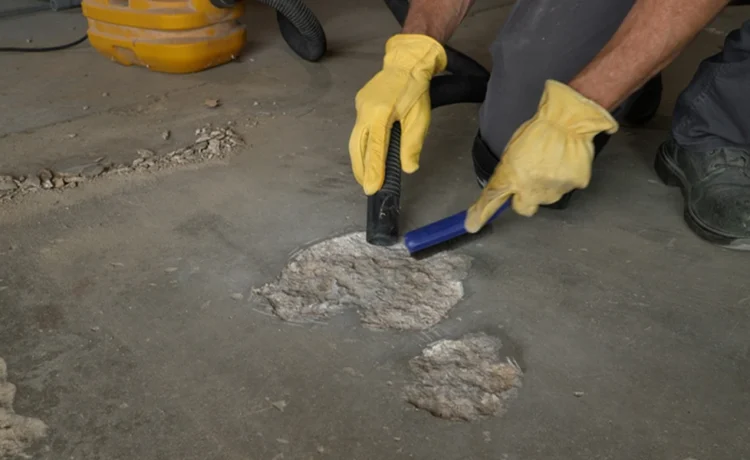
Once the extent of the damage is mapped, all unsound concrete gets broken out, usually with a combination of mechanical breakers and hand tools to avoid over-cutting into structurally sound material nearby. This step matters more than it might seem, because leaving even a small pocket of carbonated or chloride-contaminated concrete against the rebar undermines the whole repair, giving corrosion a foothold to restart from inside a patch that looks fine from the outside. Contractors typically cut back to a square or defined edge rather than a ragged one, since sharp feather edges in a repair mortar tend to crack and debond faster than a properly keyed-in edge.
Treating the Exposed Reinforcement Bars
With the surrounding concrete cleared away, the rebar itself needs attention before anything gets rebuilt around it. Loose rust and scale are removed, typically by grit blasting or wire brushing back to bright steel, and where a bar has lost too much of its original cross-section to corrosion, it may need to be supplemented or spliced with additional steel rather than simply coated over. A corrosion-inhibiting primer is then applied to the cleaned rebar, giving it a fresh protective barrier before it gets sealed back inside new concrete. Readers who want to see how these stages fit together in sequence on an actual project can look at this breakdown of the professional stages involved in spalling concrete repair, which walks through the process from initial assessment through to final protection.
Rebuilding the Section With Repair Mortar
The repair itself uses a purpose-built polymer-modified repair mortar rather than ordinary concrete mix, chosen because it bonds well to the existing substrate, resists shrinkage cracking as it cures, and can be built up in the layers needed to match the original profile of a beam, column, or slab soffit. On vertical or overhead surfaces, such as the underside of a car park deck, the mortar needs enough body to stay in place without sagging before it sets, which is part of why this work usually goes to contractors experienced specifically in structural repair rather than general renovation crews. The finished surface gets trowelled to match the surrounding concrete as closely as practical.
Where This Shows Up Most in Singapore Buildings
Multi-storey car parks are a common site for spalling because vehicle exhaust raises localised carbon dioxide levels and the concrete rarely gets a proper wash-down, but the defect turns up just as often on balcony ledges, external corridor soffits, and rooftop parapets exposed to years of tropical rain and sun. Condominium facade elements and RC ledges below air-conditioner ledges are another frequent location, since water tends to pool at these projections and slowly work its way into hairline construction cracks that were never sealed. Older HDB blocks approaching their upgrading cycle often reveal several spalling patches at once during a routine facade inspection, simply because decades of exposure catch up with multiple weak points around the same time.
Protecting the Repair From Repeating Itself
A patched section left bare is likely to spall again eventually, since it sits in the same carbonated or chloride-exposed environment that caused the original failure. Applying an anti-carbonation coating or a protective sealer over the repaired area, and often across the surrounding sound concrete as well, slows the rate at which new carbon dioxide or moisture can reach the rebar. In coastal-facing or heavily trafficked areas such as multi-storey car parks, this protective step often matters as much as the structural repair itself for determining how many years pass before the same wall needs attention again.